Vineyard has gone from about 140 residents in 2010 to nearly 17,000 today, and no single project explains that growth better than Utah City. If you haven't driven through the old Geneva Steel site along Utah Lake recently, it's worth a look, because what's rising there is one of the most ambitious developments Utah County has ever seen.
What Utah City Actually Is
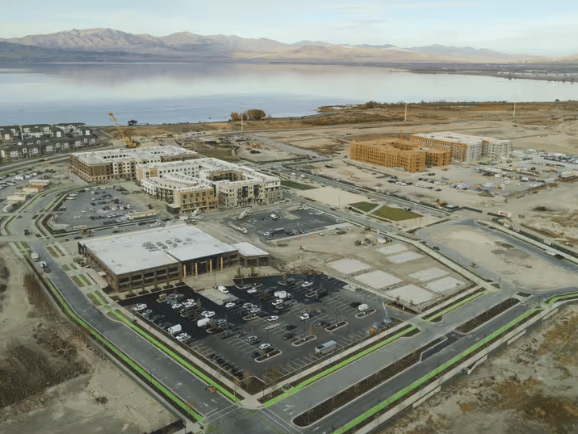
Utah City is a 700-acre master-planned "urban core" being built on the site of the former Geneva Steel mill, along the eastern shore of Utah Lake. It's a joint venture between two Utah developers, Flagship and Woodbury Corporation, operating together under a partnership called Flagborough. The master plan itself was designed by Jeff Speck, the nationally known walkability expert and author of "Walkable City," working alongside DPZ, the town-planning firm founded by New Urbanism pioneer Andrés Duany.
At full build-out, the plan calls for more than 17 million square feet of mixed-use space, homes, shops, restaurants, offices, and hotels, spread across five distinct districts with more than 50 acres of parks and walking paths. There's no published completion date, and the developers themselves describe a build-out measured in decades, not years.
What's Already Open
This isn't a rendering anymore. The first two residential buildings opened with more than 450 units, ranging from studio apartments to three-bedroom townhomes, and both are leasing now. A second residential phase already under construction will add roughly 846 more units and over 71,000 square feet of additional retail.
Bella's Market, an upscale grocery store, was one of the development's first businesses to open. The Greenline, a 12-acre corridor of parks and public space connecting the Vineyard FrontRunner station straight to the Utah Lake shoreline, has also started opening in pieces, including an all-abilities playground anchored by a nearly 35-foot climbing structure, a splash pad, and space eventually planned for a dog park, volleyball courts, and a concert venue.
The Anchor That Changes the Math
The single biggest anchor tenant is a second headquarters campus for the Huntsman Cancer Institute, a 272,000-square-foot, $400 million facility that broke ground in 2025, with patient visits anticipated in 2028. A project of that scale brings permanent jobs and daily foot traffic that a typical mixed-use development doesn't have, and it's a meaningful part of why Utah City is being taken seriously as a long-term employment center, not just a place to live.
Utah's First Geothermal District Utility
One detail that hasn't gotten as much attention as it deserves: Utah City is home to the state's first geothermal and recycled waste heat thermal public utility, approved through Corix as a designated heat corporation. The system is designed to heat and cool every residential and commercial building across the development using geothermal technology and recycled waste heat, rather than traditional gas or electric systems building by building. It's a genuinely unusual piece of infrastructure for a Utah development, and it signals how deliberately this project has been engineered from the ground up.
Why This Matters If You're Buying, Selling, or Investing Nearby
Utah City sits between BYU in Provo and UVU in Orem, with direct access to the Vineyard FrontRunner station and I-15. Even for buyers who have no interest in living inside Utah City itself, its ripple effect on Vineyard and the surrounding Orem corridor is real. New retail, dining, and grocery options raise the day-to-day appeal of nearby neighborhoods. A major employment anchor like Huntsman Cancer Institute adds long-term housing demand nearby. And a development of this scale tends to draw continued infrastructure investment to the surrounding area over time.
For investors, this is exactly the kind of anchor project worth watching in a growth corridor, not because of what it is today, but because of what tends to happen to surrounding property values over a ten-to-twenty-year build-out timeline once an anchor like this is fully underway.
What to Watch For Next
Expect continued residential phases, more retail openings, and progress on the Greenline through the rest of 2026. There's no fixed completion date for the full 700-acre vision, so this is a project to check back in on periodically rather than something that resolves in a single news cycle.
Frequently Asked Questions
Is Utah City an actual city?
No. Despite the name, Utah City is a private real estate development inside the existing, incorporated city of Vineyard. It's a branding choice, not a separate municipality.How big is Utah City when finished?
The full plan calls for more than 17 million square feet of mixed-use space across five districts and more than 50 acres of parks, though the developers describe the build-out as a decades-long process.What residential options are currently available in Utah City?
The first phase includes more than 450 units ranging from studio apartments to three-bedroom townhomes, currently leasing, with a second phase of roughly 846 more units already under construction.What is the Huntsman Cancer Institute campus at Utah City?
It's a 272,000-square-foot, $400 million second headquarters campus that broke ground in 2025, with patient visits expected to begin in 2028.Does Utah City really use geothermal heating and cooling?
Yes. It's home to Utah's first geothermal and recycled waste heat district thermal public utility, designed to heat and cool every building in the development.Is Vineyard a good area for real estate investment right now?
Vineyard has grown from around 140 residents in 2010 to nearly 17,000 today, and a project the scale of Utah City tends to draw continued investment to the surrounding area over a long build-out. It's worth a conversation about your specific goals and timeline.How does Utah City connect to the rest of Utah County?
It sits directly on the Vineyard FrontRunner commuter rail line with access to I-15, and it's positioned between BYU in Provo and UVU in Orem.
This article is for general informational purposes only and reflects publicly available information at the time of writing. It is not legal, tax, or financial advice. Market data, development proposals, and city decisions can change, so confirm current information with relevant sources and consult qualified professionals for advice specific to your situation.