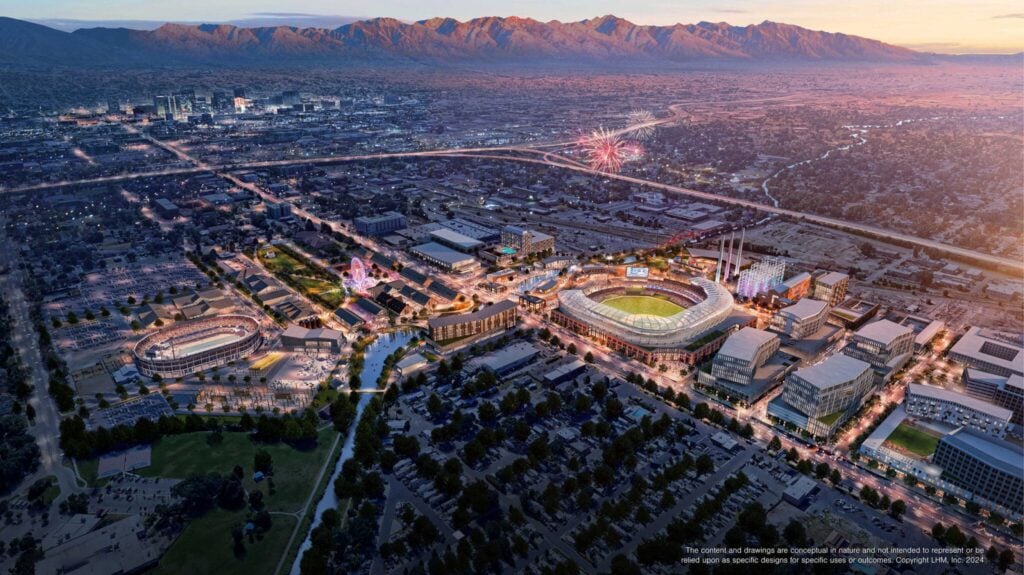
As of May 2026, Salt Lake City is considered one of the top two frontrunners for a Major League Baseball expansion team, alongside Nashville. The Larry H. Miller Company has committed $3.5 billion in private investment to the Power District, a 100-acre mixed-use development on Salt Lake City's west side. The master plan includes a proposed stadium site, 4,700 housing units, 320,000 square feet of retail, and one mile of Jordan River access. MLB Commissioner Rob Manfred has said an expansion decision will come before he retires in 2029. If it lands in Utah, the effect on real estate in Salt Lake County will be hard to ignore.
What Is the Power District, and Why Does It Matter?
The Power District isn't a ballpark. Not yet.
Right now it's a 100-acre construction site on Salt Lake City's west side, bordered by North Temple, the Jordan River, and a light-rail line that connects directly to downtown and Salt Lake City International Airport. Rocky Mountain Power broke ground on its new 10-story, 300,000-square-foot corporate campus there in October 2025. That was the first physical sign this development is actually moving.
The master plan calls for a potential MLB stadium, 4,700 housing units across multiple price points, 300 hotel rooms, 320,000 square feet of retail and dining, and a complete revitalization of a mile-long stretch of the Jordan River with trails and riverfront access. The Larry H. Miller Company has secured more than $3.5 billion in private investment. Utah's legislature authorized up to $900 million in public funding through legislation that passed with strong bipartisan support.
This is not a rendering on a website. Shovels are in the ground.
Is Utah Actually Getting an MLB Team?
Salt Lake City and Nashville are widely considered the two leading candidates for MLB's next expansion team. The Athletic called Utah "a sports boomtown" and a frontrunner. Sports radio personality Chris Russo said publicly that when MLB expands to 32 teams, "I think Salt Lake City and Nashville will be the two teams."
The Larry H. Miller Company wants the old Rocky Mountain Power site prepped for stadium construction by October 2026, when collective bargaining with MLB is expected to take place and expansion talks could formally begin.
Nothing is official yet. Commissioner Manfred has been clear that no expansion announcement comes until the Tampa Bay Rays' ballpark situation is resolved, and he won't move on it until he's ready before his 2029 retirement. Utah is well-positioned. It's not a done deal.
What is a done deal: $3.5 billion in development is already underway. That part happens whether baseball comes or not.
What This Kind of Development Does to a Real Estate Market
Stadium districts don't just attract fans on game days. The ones that work, and the Power District is designed to work, function as year-round urban anchors.
Look at what happened in neighborhoods surrounding major mixed-use developments in other cities. Property values in walkable proximity climbed. New residential construction accelerated. Demand from renters and buyers shifted toward districts that previously had little appeal.
Salt Lake City's west side, specifically the Fairpark neighborhood and surrounding blocks, has historically been undervalued relative to the rest of the city. A mixed-use district with riverfront access, a corporate anchor tenant (Rocky Mountain Power is already moving in), retail, hospitality, and possibly a professional sports franchise changes that math entirely.
The people who buy before the announcement benefit most from the announcement.
What We're Seeing in the Market Right Now
In our experience working with buyers across Salt Lake and Utah Counties, the people asking the smartest questions right now are the ones who understand that Utah's growth story isn't just population. It's infrastructure.
NHL Utah Mammoths. NBA Jazz. 2034 Winter Olympics already confirmed. The Power District under construction. Delta Center being renovated to NHL standards. Silicon Slopes continuing to pull tech employers into the corridor between Lehi and Salt Lake.
Each of those pieces individually moves housing demand. Together, they're building a market that looks nothing like it did five years ago, and likely nothing like it will five years from now.
Buyers relocating from California, Washington, and Texas ask us constantly whether they've missed the window. The honest answer is: parts of it, yes. But Salt Lake County's west side, areas within commute range of the Power District, and Utah County cities that feed into the broader metro are still priced with real headroom compared to markets with this level of infrastructure investment.
What Buyers and Sellers Should Actually Do with This Information
If you're buying in Salt Lake County in 2026, the Power District development should factor into your thinking. Not as a speculation play, but as context for where the city's growth is heading and how that affects values in surrounding areas.
If you're selling in Salt Lake or Utah County in the next 12 to 24 months, the story you're telling prospective buyers is a strong one. Utah's sports and infrastructure growth is a legitimate selling point, and buyers from out of state respond to it.
If you're sitting on the fence, the development timeline is a useful forcing function. The Power District site is expected to be stadium-ready by late 2026. An MLB announcement, if it comes, will move markets quickly. It's worth having a clear position before that happens rather than reacting to it.
FAQ
Is Salt Lake City definitely getting an MLB team?
Not officially. MLB Commissioner Rob Manfred has indicated a decision will come before he retires in 2029, and Salt Lake City is widely considered a frontrunner alongside Nashville. The Larry H. Miller Company has $3.5 billion committed to the Power District and wants the stadium site shovel-ready by October 2026. No formal announcement has been made.
What is the Power District?
The Power District is a 100-acre mixed-use development on Salt Lake City's west side, led by the Larry H. Miller Company. The master plan includes a potential MLB stadium, 4,700 housing units, 320,000 square feet of retail, 300 hotel rooms, and one mile of Jordan River riverfront access. Rocky Mountain Power broke ground on its new 10-story headquarters there in October 2025.
How much is Utah investing in the Power District?
The Larry H. Miller Company has secured more than $3.5 billion in private investment. The state of Utah has authorized up to $900 million in public funding, structured to capture new tax revenue generated by the development itself.
Does an MLB stadium actually increase nearby property values?
Mixed-use stadium districts, where a stadium anchors retail, residential, and hospitality development, have historically had a more positive impact on surrounding neighborhoods than standalone sports venues. The Power District is designed as a full urban district, not just a ballpark. That's the key distinction.
Where is the Power District located?
The site is on Salt Lake City's west side near North Temple, minutes from Salt Lake City International Airport and downtown, on an existing TRAX light-rail line, and adjacent to the Jordan River and Utah State Fairpark.
How does this affect Utah County real estate?
Utah County buyers who work in or near Salt Lake will increasingly value proximity to a major downtown employment and entertainment district. The Power District, if fully built out, adds another pull toward the broader Wasatch Front metro, which supports demand across Utah County cities like Lehi, Saratoga Springs, and Eagle Mountain.
When should I make a move if I'm interested in buying near this development?
Buyers who are serious about Salt Lake County should have a clear picture of their criteria before any MLB announcement, which could come as early as late 2026 or 2027. Announcements of this scale tend to accelerate buyer activity quickly. Reach out and we'll walk through what makes sense for your situation.
What other Utah sports or infrastructure investments should buyers know about?
The Utah Mammoths began play in 2025. The Delta Center is being renovated to NHL standards. The 2034 Winter Olympics are confirmed for Utah. Silicon Slopes continues to grow along the I-15 corridor from Lehi to Salt Lake. Each of these adds to the case for long-term Utah real estate demand.
The Bottom Line
Whether or not Utah lands an MLB team, Salt Lake City's west side is being rebuilt from the ground up. $3.5 billion in private investment is already in motion. The state is committed. The city is committed. The Larry H. Miller Company is committed.
Sports franchises follow cities that are building. Utah has been building for years. The Power District is just the most visible sign of it right now.
If you're thinking about buying or selling in Utah County or Salt Lake County and want to understand how these developments affect your specific situation, reach out to Foundry Group. That's exactly the kind of conversation we're built for.