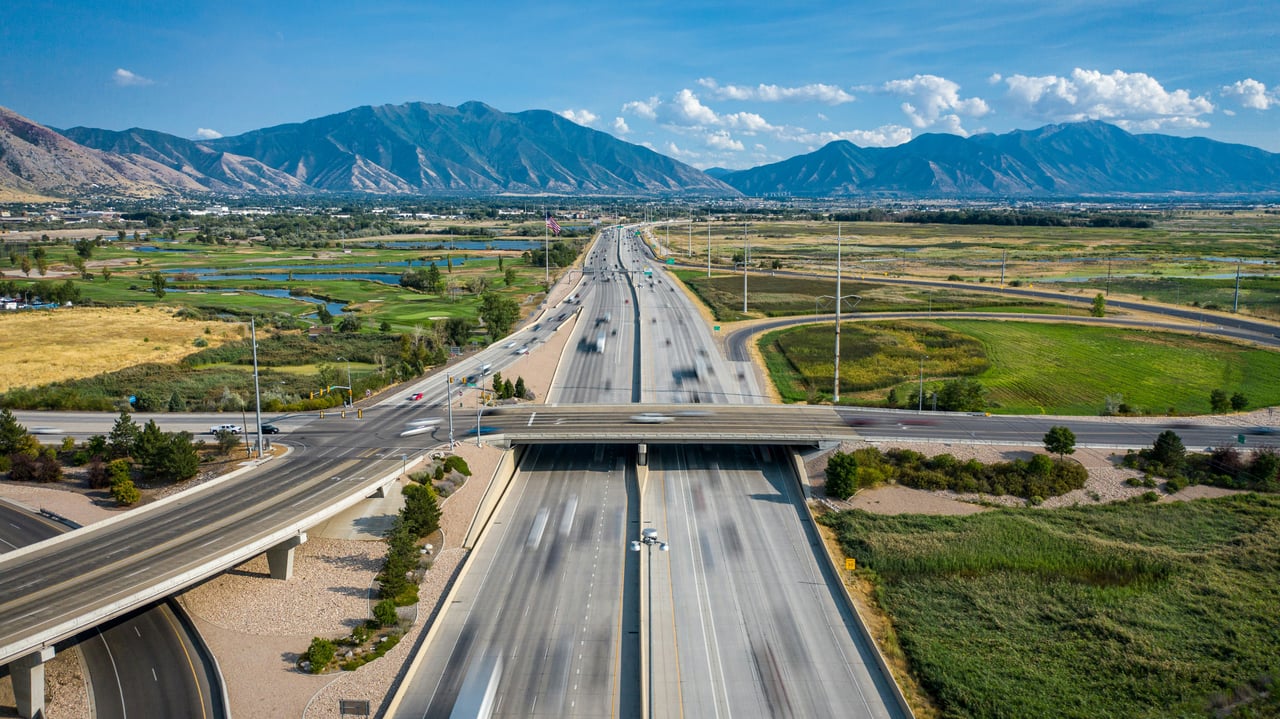
Most homeowners find out about the construction near them when the orange cones show up. By then, the decisions were made years ago, the funding was already approved, and the project was simply waiting its turn.
Utah County is in the middle of the largest infrastructure investment the region has seen since the I-15 CORE reconstruction completed in 2012. If you own a home here, or you're considering buying one, it's worth knowing what's actually underway and what it means for where you live.
The scale of what's happening
Utah County is projected to grow faster than Salt Lake, Davis, and Weber counties combined by 2050, according to the Kem C. Gardner Policy Institute. The state has responded with roughly $2.1 billion in transportation funding committed to northwest Utah County alone through the end of the decade, concentrated in Lehi, Saratoga Springs, and Eagle Mountain, the cities absorbing the fastest growth.
Statewide, UDOT is beginning 176 new construction projects in 2026 worth approximately $2.8 billion, while simultaneously finishing 57 projects that were already underway. A meaningful share of that activity is happening right here.
The Lehi freeway-to-freeway connection
Construction broke ground this spring on a $621 million project converting 2100 North in Lehi into a full freeway connection between Mountain View Corridor and I-15. The project includes 14 new bridges, two pedestrian bridges, and two miles of shared paths, and it's expected to take until the end of 2028 to complete.
If you own property near this corridor, or you're considering buying there, this is the kind of project that changes commute times and access significantly once it's finished. It's also the kind of project that creates years of construction disruption before that payoff arrives, which matters if you're weighing a purchase near the route right now.
Mountain View Corridor extension to Saratoga Springs
A $553 million project will extend Mountain View Corridor south to Cory Wride Highway, also known as SR-73, in Saratoga Springs. This creates an alternate freeway connection between northwest Utah County and Salt Lake County, intended specifically to relieve pressure on Redwood Road and I-15 near the Point of the Mountain. Construction is expected to begin as early as 2027.
Combined with a separate $459 million project to build the Cory Wride Freeway itself from Mountain View Corridor to Ranches Parkway in Eagle Mountain, this is one of the more consequential projects for buyers looking at Saratoga Springs and Eagle Mountain over the next several years.
Pioneer Crossing flex lanes
Nightly construction began this year on flex lanes along Pioneer Crossing between I-15 and Redwood Road in Saratoga Springs. The system allows up to four lanes of travel in the peak commute direction, easing the corridor that currently serves as the primary connector for a significant share of northwest Utah County's commuters. UDOT estimates the change will save drivers roughly six minutes during rush hour and reduce congestion by more than 900 hours daily across the corridor. Construction is expected to run through late 2026.
Saratoga Springs residential growth
Beyond the freeway projects, Saratoga Springs has multiple active residential developments moving through approval right now, including phases of the Wildflower, Wander, and Sierra Estates communities, along with newer projects like Riverwalk and The Reserve on the Lake currently in preliminary plat review. If you're considering a home in Saratoga Springs, checking the city's active applications list before you buy will tell you exactly what's planned near a specific property, not just what exists today.
What this means if you already own here
If your home sits near one of these corridors, the short-term reality is construction noise and traffic disruption, sometimes for a year or more. The longer-term reality is usually appreciation. Infrastructure investment at this scale tends to precede private development and increased demand, particularly in areas that were previously harder to access.
We track these projects specifically because they affect how we advise both buyers and sellers. A seller in a path-of-growth area often benefits from understanding the project timeline before listing. A buyer evaluating the same area benefits from knowing whether they're buying ahead of the improvement or in the middle of years of construction.
What this means if you're considering buying here
Buying in an area with major infrastructure underway is not inherently good or bad. It depends on your time horizon and your tolerance for near-term disruption in exchange for longer-term access and value. A family planning to stay 10 years has a different calculus than someone planning to move again in two.
If you're weighing a purchase near any of these corridors, reach out to Foundry Group before you write an offer. We can walk through what's approved, what's funded, and what the realistic timeline looks like for the specific area you're considering.
FAQ
What major road projects are currently underway in Utah County?
The largest active projects include a $621 million freeway-to-freeway connection in Lehi linking Mountain View Corridor and I-15, a $553 million Mountain View Corridor extension to Saratoga Springs, a $459 million Cory Wride Freeway project in Eagle Mountain, and Pioneer Crossing flex lane construction between I-15 and Redwood Road in Saratoga Springs.
How much is being invested in Utah County infrastructure right now?
Roughly $2.1 billion in transportation funding has been committed to northwest Utah County through the end of the decade, concentrated in Lehi, Saratoga Springs, and Eagle Mountain. Statewide, UDOT is beginning 176 new projects in 2026 worth approximately $2.8 billion.
When will the Lehi freeway-to-freeway connection be finished?
Construction broke ground in spring 2026 and is expected to be completed by the end of 2028. The project will connect Mountain View Corridor and I-15 along a 2.8-mile stretch and includes 14 new bridges.
Why is so much infrastructure investment going into northwest Utah County specifically?
Lehi, Saratoga Springs, and Eagle Mountain are absorbing the fastest population growth in the county. Utah County overall is projected to grow faster than Salt Lake, Davis, and Weber counties combined by 2050, according to the Kem C. Gardner Policy Institute, and the state is investing ahead of that growth.
How can I find out what's been approved to be built near a specific home I'm considering?
City planning departments publish active applications and approved development plans online. For Saratoga Springs specifically, the city maintains a public list of pending and recently approved applications. We check this directly for our clients before they write an offer on a property.
Does infrastructure construction near a home hurt its value?
In the short term, construction can mean noise and access disruption, sometimes for a year or more. In most cases, the infrastructure investment itself signals strong long-term demand and tends to precede appreciation rather than hurt it, particularly once the project is complete and access improves.